
Four books on grief

I’m really bad at book reviews. Maybe that’s because I never write them. I thought this would be a good time to practice, to do a few really short ones that fall under the same theme.
Grief is nebulous and tricky, I find. It’s unexpected and yet completely predictable. I want it to be different than it is, last longer, feel worse. I want to be constantly reminded that I’m missing my sister, Loey, that she isn’t here. I’ve been wearing her clothes a lot this winter. Her sweaters. Her earrings. I want to be sad all the time. But honestly, sometimes I forget about it for a little bit. Sometimes I’m not sad. And then, when I least expect it, I see a stupid InstaGram post that I want to send to her because it made me laugh. Or I need to call her to talk to her about something going on with my kids. Then it feels pretty bad and I get really sad again, and God, I’m so thankful for the painful and burning rush of those emotions. My younger sister and I recently got a tattoo so that we’d be reminded more often, a visual trigger. It’s definitely an awkward conversation starter, and well, I guess that’s part of grief too. Bring it on.
Here are four books on grief that may or may not have affected my own process of grieving.
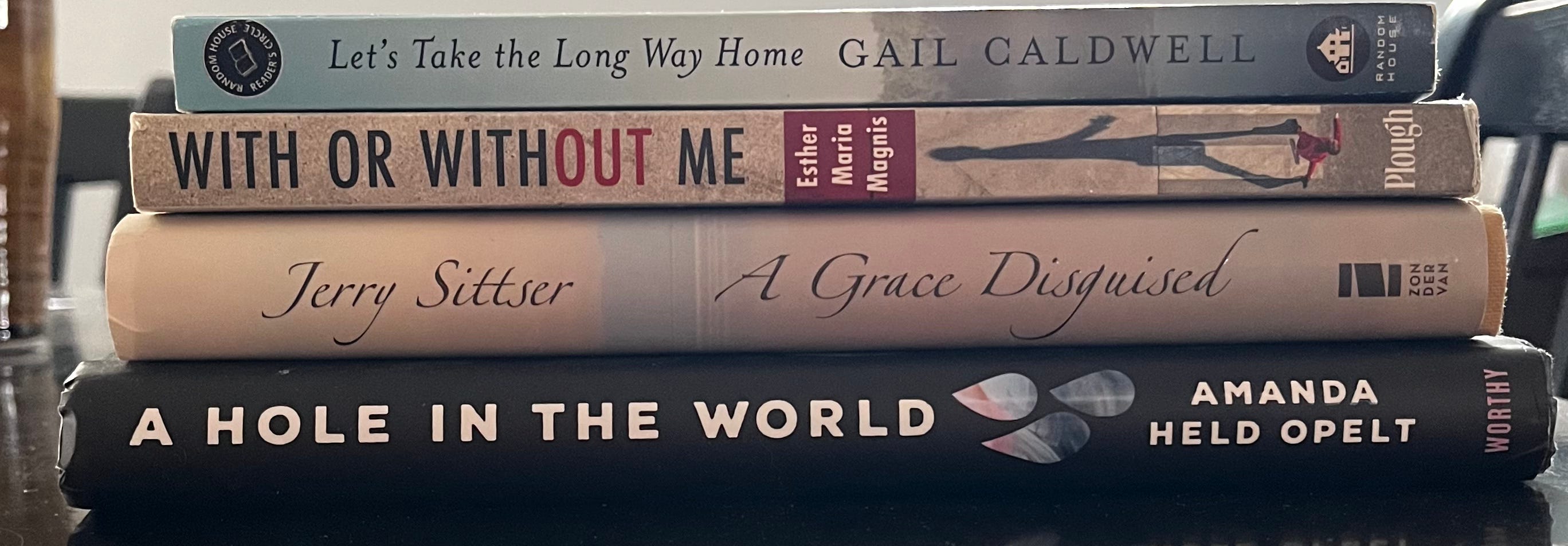
Let’s Take The Long Way Home by Gail Caldwell.
Given to me by a friend, this is a book about a friendship between two women and their dogs. It’s lovely and it’s very sad, since, spoiler alert, one of the women dies as well as one of the dogs. Gail is a journalist, a writer’s writer, and this is just a very well-written story with wisdom and reflection sprinkled throughout. I read this a year or so before Loey died and had some thoughts about what losing her might be like as I read it; but my wonderings couldn’t have prepared me for the reality. No book or thinking ahead can do that. Well, at least not for me.
The only education in grief that any of us ever gets is a crash course. Until Caroline died I had belonged to that other world, the place of innocence and linear expectations, where I thought grief was a simple, wrenching realm of sadness and longing that gradually receded. What that definition left out was the body blow that loss inflicts, as well as the temporary madness, and a range of less straightforward emotions shocking in their intensity.
A Grace Disguised by Jerry Sittser. Jerry’s family was in a horrible car accident and in a matter of moments he lost his wife, his mother, and one of his young kids. This is a book by a Christian who is well-acquainted with grief, though his was such a catastrophic loss, I can’t really relate. The recent loss I have experienced seems so much smaller and more manageable. This is not memoir, but he writes in hopes that he can help people deal with devastating loss by tackling hard questions of faith that the grieving are likely to ask.
Sorrow indicates that people who have suffered loss are living authentically in a world of misery, and it expresses the emotional anguish of people who feel pain for themselves or for others. Sorrow is noble and gracious. It enlarges the soul until the soul is capable of mourning and rejoicing simultaneously, of feeling the world’s pain and hoping for the world’s feeling at the same time.
A Hole In The World by Amanda Held Opelt. Amanda wrote this book after a season of deaths, including her sister’s. She felt unprepared for grief, didn’t know how to mourn, and so looked to the past to discover “rituals surrounding death that allowed mourners to be present in the experience of bereavement.” A friend of mine sent this to me after Loey died, and I read it right away. Some of the chapters didn’t interest me, like “Keening” and “Telling the Bees.” I’m not compelled to cry aloud in anguish or talk to bees— weird! But other chapters like “Sitting Shiva” and “Wearing Black” seem like good practices to acknowledge death over an extended period of time. Whatever happened to the practice of wearing black for a year and not being social? Read the book to find out. The downfall of this book was that I could tell when the author was really interested in a practice and when she really wasn’t— some chapters seemed to deteriorate into paragraphs of lists of “and then...”, “and then...”, like she was hurrying to get the information out so she could move on. This book didn’t help me grieve, per se, but did get me thinking on what I need to do in remembrance of Loey’s death.
You are supposed to fumble through grief.
With Or Without Me by Esther Magnis. This is a raw and honest memoir by a young woman who experienced the death of her father as a teenager, the ensuing silence of God, losing and finding her faith. I read this book years ago after listening to an interview with the author, who talked about how her father’s death killed and then resurrected her faith in God. I grew up hearing that if you lose your faith, that’s it, you’re done, so I really appreciated her perspective. In the interview, she said that our expectations of God, our assumptions of who he is make him small, and this leads us to be disappointed in him.
I prefer this book because Esther’s narrative felt so much more real, less filtered and staid than the others. She isn’t trying to teach anything. This is definitely not a how-to. This is just her story, how dealing with grief was for her. It’s messy and wild. She got really angry. She got really drunk— many, many times. She swore a lot. She smoked tons of cigarettes. She asked God where he was— she howled at him. And as time went by, little by little, he brought her back around.
No lightning struck in the years following Dad’s death. No voice rumbled forth in thunder. No hot coals burned my tongue, no Christ came to me in a dream, no sea parted, no pillar of fire appeared, and no wind whispered. There was no choir of angels, not even a lone angel, nor was my name called by God. There was nothing. God was silent.
And I will never forget that silence. Today, I sometimes think that there is a power in his silence— a power we cannot even imagine.
…There were no more questions directed inward, no more hatred whisperings from within. But God must have been even quieter than all that.
…There must be power there we do not understand.
This is the last post from me until April. I have decided to give up writing for and checking Substack for Lent this year— and who’s to say that I’ll pick it back up again when Lent is over?
Just kidding, I will. Sorry to scare you.
Clearing of throat. Umm, who said you are not good at book reviews? Because of your candid reviews, each one of these books is now on my reading list. And not just because I am writing about death and dying. With deep appreciation!
Jen, I really appreciated your email and your book reviews. Please consider reading Kathy’s Meditation on the family thread she gave after Abe’s death.